West Virginia Talk: Words & Phrases From The Mountain State
@ Copyright/Eva Smith-Carroll
Unless otherwise indicated, these entries are expressions that I first heard during the 1950s and 1960s when I was growing up on White Oak Mountain on our farm near the Raleigh/Summers county line. After some of the phrases I have included information from references. And I have added contributions from visitors to this site. If you have a West Virginia word or saying you want to share, please e-mail me. To help “place” the saying and put it in context, include your birthplace and age (optional, of course) and where and when you heard the expression. For example: Raleigh County, 1950s.
A
about to find pups – Pregnant. When I discovered my dog Lady had puppies, I ran “out the path” to my grandparents’ house to tell the news. I was mystified when my grandpa Leonard Vest wasn’t surprised. How did he know? The state of expectant motherhood, animal or human, wasn’t a topic of conversation.
accafortis, strong as – Strong in flavor. “That coffee is as strong as accafortis.” Another expression: strong as all get out. A contributor to the Phrase Finder site said about accafortis: “This sounds like a corruption of ‘aqua fortis’ (Latin: ‘strong water’), which means nitric acid.” Also, I found the term in a book about phrases used by individual families:
“Anything that is especially strong in flavor, taste, or muscular ability is ‘stronger than accafortis’ in the family of Kenneth P. Weinkauf of Athens, Ohio. Nobody in the family knows what it means.” (Family Words: The Dictionary for People Who Don’t Know a Frone from a Brinkle by Paul Dickson, Addison-Wesley Publishing Co., 1988.)
ackempucky – Any food mixture of unknown ingredients, West Virginia. From Informal English: Puncture Ladies, Egg Harbors, Mississippi Marbles, and Other Curious Words and Phrases of North America by Jeffrey Kacirk, Touchstone, New York, 2005, Page 1. Mr. Kacirk cites Harold Wentworth, The American Dialect Dictionary, New York, 1944.
act ugly – Be ill tempered; misbehave. "Now, don't act ugly." Also, a second meaning: have illicit sex.
acting (getting) above your raisin’ – Conducting yourself in a manner that indicates the people and things of your childhood are now beneath you.
addled – Confused. “I’ve been addled since I hit my head.” It can also mean mental impairment. “That boy has been addled since he was born.”
B
bad off – Seriously ill. “I heard William is bad off.” The next phase would be “at the point of death.”
Bad Off Mountain – Batoff Mountain or Badoff Mountain in Raleigh County, W.Va.
According to columnist Shirley Donnelly, the original name was Bateaux Mountain from bateaux, “long, narrow boats” that were “poled along New River. McCreery was as far as they could pole the boats. There the bateaux were tied to trees to be taken back up-stream. That led to calling the mountain there ‘Bateaux’ Mountain. That was corrupted to Badoff and in turn that was misspelled as ‘Batoff,’ hence Batoff Mountain today.” (Yesterday and Today: McCreery, Royal Sport Raleigh History, Shirley Donnelly, Post-Herald, Beckley, W.Va., 23 Aug 1968, Page 4.) Bateaux - Merriam-Webster
Detroit Lad Lost in Woods/Found on Batoff Mountain, The Sunday Register, Beckley, W.Va., 21 May 1939, Page 14. Billy Robertson has an adventure.
bad to – Made a habit of; prone to. “He was bad to drink.” “Here lately I’ve been bad to fall down.”
bag store/state store – A state-run liquor store. At one time privately owned liquor stores weren’t legal in West Virginia. “Bag store” refers to the little paper bags used to hold the bottles. “I see you’ve been to the bag store.” See poke store.
balloon ascension – JTF wrote that when something was slowly making his grandmother angry, “…she claimed to be taking a ‘balloon ascension.’” Wheeling, W.Va., 1950s. I am guessing balloon ascension is related to this phrase:
The balloon goes up -- trouble is brewing. During World War I and II, observatory or defensive barrage balloons were launched skyward before battle. “The mere fact that these…balloons had ‘gone up’ would signal that some form of action was imminent.” War Slang: American Fighting Words and Phrases from the Civil War to the War in Iraq, Second Edition, by Paul Dickson, 2007, First Bristol Park Books, New York. Page 337.
bealed – Red and inflamed. My great aunt Sarah Vest told her granddaughter Carolyn and me that we would get “bealed heads” from sun-bathing. And we did.
Bible divorce – If a spouse commits adultery, the innocent party may get a divorce and remarry without religious censure. A person who divorces on grounds other than adultery and marries again is considered by some to be committing adultery with the new spouse.
big as a skint mule – A "stout," that is muscular and strong, man. Probably alludes to being ripped with highly visible, defined muscles. Submitted by Joel, Lincoln County, W.Va.
big bug -- Someone who is important -- or thinks he is. "He's one of the big bugs."
big dinner – Church reunion, “dinner on the ground.” “Are you going to the big dinner at New Salem Missionary Baptist Church this year?” 106-Year-Old Church Keeps Up Homecoming Tradition, 1976 article.
biggidy – Acting biggidy is related to “too big for your britches.” See also Acting above your raisin’ and briggity.
Horace Kephart said “biggety” was “negro lingo.” (I can testify that it was also used by white folks in Raleigh County, W.Va.) “Smoky Mountain Voices: A Lexicon of Southern Appalachian Speech Based on the Research of Horace Kephart,” edited by Harold J. Farwell Jr., and J. Karl Nicholas (University Press of Kentucky, Lexington, Ky., 1993). Page 33.
bite to eat – A meal fit for a king was still called “a bite to eat.” To say otherwise was bragging. When company came and the food was ready, my mother would say, “I’ve fixed a bite to eat.” The “bite” to eat would include one, maybe two meats, corn, peas, beans, mashed potatoes, sliced cucumbers and tomatoes, cole slaw, cornbread or biscuits, “light” bread, hot coffee, sweet milk for the kids, and pie and cake.
Blow George – A big talker, someone who is boastful and windy. It was considered impolite to tell of your accomplishments or possessions. The only person I'd heard use this term was my West Virginia coal miner father. Karen, a visitor to this page, reports that her mother, who was raised in Belfry, Pike County, Ky., also says "Blow George." The maternal side of her mother's family was from Wayne County, W.Va. Just goes to show that a colorful phrase knows no borders.
According to a Wikipedia article, a “Blow George” is an implement held against the surround of an open fire to accelerate the chimney draw. It was named after George Atkinson of England. “Atkinson applied similar principles to mine shaft ventilation, and later to steam engines, and in each case referred to the device as a ‘Blow George.’”
blink milk – sour milk. I’ve never heard this expression but I found it on a Web site: West Virginia Sayings, TheSolutionSite.com--K-12 thematic units with lesson plans. Accessed March 4, 2003.
The verb “blink” means “to turn sour” and comes from “blink” meaning “to exercise an evil influence, bewitch, hence to sour (souring of milk being formerly ascribed to witchcraft).” (Dictionary of American Regional English, Volume 1 by Frederic G. Cassidy (1985, Belknap Press of Harvard University Press, Cambridge, Mass., and London, England). Page 284.) This reference also lists another term for sour milk -- “blue john.”
boys/girls – Sisters and brothers. “The ‘Underwood boys’ lived next to my family.”
brand-fired new/brand-spanking new – New. These are variations on “brand-new.”
“‘Brand-new has nothing to do with the brand name of a product. It is rather associated with the word ‘brand’ that is cognate with ‘fire,’ as in firebrand. The product would thus be fresh from the anvil, or as Shakespeare put it in ‘Twelfth Night,’ ‘fire-new.’” (Encyclopedia of Word and Phrase Origins by Robert Hendrickson, Facts on File, New York, 1997). According to a second reference, the word “brand” “…dates back to the Middle Ages and earlier, when ‘brand’ meant ‘flame or torch’ as it does in the still current phrase ‘snatching a ‘brand’ from the burning.’ The description ‘brand-new’ in those days was applied to products – usually made of metal – newly taken from the flames in which they were molded.” (Morris Dictionary of Word and Phrase Origins by William and Mary Morris, HarperCollins, New York, 1977, 1988.)
briggity – “I often heard my mother refer to a girl or young woman who was showing off or flirty as ‘briggity.” Joel, who grew up in Lincoln County, W.Va., during the 30s and 40s. See also biggity.
A reference has several spellings: brigaty, brigetty, briggidy and briggity. It is chiefly southern Appalachian and can mean self-assertive, headstrong, foppish, overbearing. “Dictionary of American Regional English,” Volume 1 by Frederic G. Cassidy (1985, Belknap Press of Harvard University Press, Cambridge, Mass., and London, England). Page 380. “[Feisty and brigaty] mean nigh about the same thing, only there's a differ. When I say that Doc Jones thar is brigaty among women-folks, hit means he’s stuck on hisself and wants to show off....feisty means when a feller's allers wigglin' about, wantin' ever'body to see him, like a kid when the preacher comes..." ” “Smoky Mountain Voices: A Lexicon of Southern Appalachian Speech Based on the Research of Horace Kephart,” edited by Harold J. Farwell Jr., and J. Karl Nicholas (University Press of Kentucky, Lexington, Ky., 1993). Page 33.
bumfuzzled – Confused. My mother, Golda Vest Smith of Raleigh County, W.Va., used this expression. A visitor to this page -- Lesa, whose family is from Union, W.Va. -- reports that her family used "bungfuzzled" to mean "completely confused about something."
burn the wind – Run fast. Submitted by Joel, Lincoln County, W.Va., 1930s and 40s. See also split the mud.
C
cabbage – See glom onto/cabbage onto and I don't chew my cabbage twice.
calf rope – "We said 'calf rope' rather than 'uncle' to give up in a wrestling match." Joel, Lincoln County, W.Va., 1930s and 40s.
A reference has call calf rope or holler calf rope. It is common in the Gulf States in the United States (Texas, Louisiana, Mississippi, Alabama and Florida). A theory is that it stems from the victor grabbing a hank of hair or a pigtail. “Dictionary of American Regional English,” Volume 1 by Frederic G. Cassidy (1985, Belknap Press of Harvard University Press, Cambridge, Mass., and London, England). Page 510.
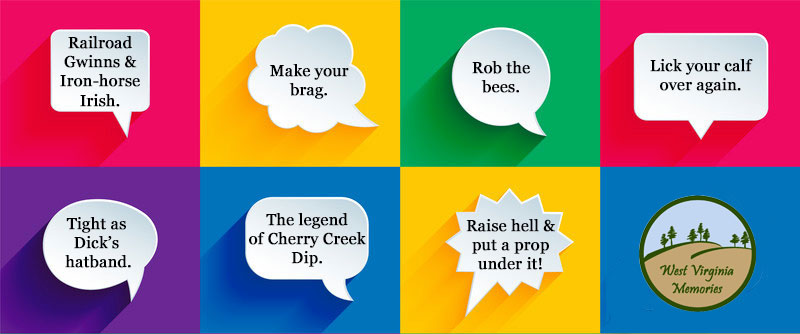
Cherry Creek dip, legend of – Cherry Creek dip is a section of road in Raleigh County. If you drive slow there at night, a ghost will get in your car. Speed up and the ghost leaves. The ghost was a person killed in a wreck and won't stay in a speeding car. A version of the story is online at wvghosts.com
Chiller Theater – Our television reception was almost nonexistent -- one "regular channel" and educational TV. So in the 1960s I would on occasion spend Saturday night with my cousin Carolyn so we could watch Chiller Theater. Good times! If you have Chiller memories, e-mail me. Chiller Theater Memories. Chiller Theater -- Wikipedia. Accessed 13 May 2010. More Chiller memories Blogger Mark Justice talks about watching Chiller Theater on Channel 13, Huntington, W.Va. Accessed 01 Aug 2011.
chow-chow – Home canned relish. “Oh, city folk would call it a relish…one of the foods the pioneers enjoyed.” (Waking ‘Em Up, The Post-Herald, Beckley, W.Va., Thursday, Oct. 12, 1944, Page 2) Two chow-chow recipes. An article on Southern Plate says it is sometimes called “end of season relish” because homemakers would gather up :a few green tomatoes, some underdeveloped peppers…some onions and cabbage” and make chow-chow. Granny’s Chow-Chow. ~ From Joyce Bacon.
chuffy/chunky – Plump. Country people apparently don’t consider it an insult to point out that a person has gained weight. "I've been eating too much and I see you have too."
churched – Taken off the church rolls for misconduct.
citified – Country people who have adopted city ways.
c***sucker – Coal-mine operator or anyone else who takes advantage of working people.
come by it honest – Married when a child is conceived.
coming up a storm – A storm is brewing. A friend was helping a Spanish-speaking neighbor practice her English. The neighbor was standing in a doorway watching the clouds roll in. She said, "It's comin' up a storm." Spoken like a true West Virginian.
cornbread in a glass – Crumple cold cornbread in a cup or glass. Add milk. Eat with a spoon.
count -- Short for account, meaning worth or value. See You reckon' they're any count?
cry buckets of tears – Grieve heavily. My mother said one of her relatives didn't lie, she exaggerated. She didn't just cry, she cried buckets of tears.
cut a rusty – Create a scene, draw attention to yourself. Perhaps behaving badly.
cyarn – When my aunt Nina Vest Bennett said my cousin Norma and I were “full of cyarn” after playing in the dirt, I took it to mean our faces needed scrubbing. Here’s another meaning:
“Cyarn (kyarn), n., — carrion, putrefying meat.” (Southern Mountain Speech by Cratis D. Williams (Berea College Press, 1992, Page 74.)
D
decorate graves – Clean off the graveyard and place flowers and other decorations on the graves. This was a family occasion. The men mowed and the women decorated the graves and assembled a picnic lunch. The children played but were cautioned to never step on the graves. Stepping on graves was disrespectful. (I took my first baby step in Smith Cemetery while my family was decorating the graves. For information about "my" graveyards, see Cemeteries page.)
"Decoration Day (often called simply 'a decoration') is a late spring or summer tradition that involves cleaning community cemeteries, decorating them with flowers, and holding a religious service in the cemetery, often with 'dinner on the ground.' Decorations seem to predate the post-Civil War celebrations that ultimately gave us our national Memorial Day. Little has been written about this tradition, but it is still practiced widely throughout the Upland South, from Virginia and North Carolina to the Ozarks and beyond." (Decoration Day in the Mountains: Traditions of Cemetery Decoration in the Southern Appalachians by Alan Jabbour and Karen Singer Jabbour. University of North Carolina Press, 2010. Book purchase information here: http://www.uncpress.unc.edu/browse/page/644 )
Didn't say "dog" – "He left and didn't say 'dog' to nobody" The person left without saying goodbye or anything else for that matter. Close-mouthed. Diana Peters, who grew up in Temple Hill, Ky., in the 1950s, remembers an expanded version: “He didn't say dog how come you put your eye out." Another variation: He was the first priest to “say turkey-dog to me about liking anything I wrote.” Flannery O’Connor, a writer born in Savannah, Ga., quoted in “Flannery: A Life of Flannery O’Connor,” by Brad Gooch, Page 279.
Never say dog, never say pea turkey – “To say nothing. The phrase expresses displeasure with someone’s lack of manners or breach of etiquette.” Never said dog, oldest citation: 1895. Pea turkey is a call to turkeys to feed. “Chickie, chickie – pea turks, pea, pea, pea.” Citation: 1940. Dictionary of Smoky Mountain English by Michael B. Montgomery and Joseph S. Hall (University of Tennessee Press, 2004), Page 410 and 439.
Irish goodbye (non-West Virginia phrase): “Ghosting—aka the Irish goodbye, the French exit, and any number of other vaguely ethnophobic terms—refers to leaving a social gathering without saying your farewells…Here in the U.S., the most-used term seems to be Irish goodbye, which, due to unfortunate historical stereotyping, hints that the vanished person was too tipsy to manage a proper denouement. Dutch leave is a less common, but apparently real, variant.” From “Don’t Say Goodbye -- Just ghost” by Seth Stevenson, Slate.com, July 3 2013.
dismals, the – Instead of "the blues," Vernon Pack's father would have the dismals. Mr. Pack, a former resident of Streeter, W.Va., contributed to Slang and Colloquialisms of Streeter, a page on The History of Streeter, West Virginia. Used with permission of the site owner.
dismals – The use of the word to mean a melancholy mood dates back to the 1700s and is often used in the phrase "weary dismals." Another definition: dismals = work clothes (1963). "Dressed in his dismals." Dictionary of American Regional English, Volume II, D-H, by Frederic G. Cassidy and Joan Houston Hall (1991, Belknap Press of Harvard University Press, Cambridge, Mass., and London, England), Page 86.
do-less – Lazy. Wouldn't hit a lick at a snake.
Don't joner me – See Jonah.
Don’t try and teach your grandma to suck eggs – Don’t try to teach an expert. I don’t think anyone knows exactly how this phrase got started. On a farm, an egg-sucking dog (a dog that steals eggs and eats them) is bad. (See egg-sucking dog.) During one discussion on Phrase Finder, it was said that maybe grandma didn’t have teeth so she sucked soft-boiled eggs.
“…This particular expression is well over two hundred years old; it is just a variation of an older theme that was absurd enough to appeal to the popular fancy. One of the earliest of these is given in Udall’s translation of ‘Apophthegmes (1542) from the works of Erasmus. It reads: ‘A swyne to teach Minerua, was a prouerbe, for which we sai: Englyshe to teach our dame to spyne.’ (don’t try to teach a dame to spin)” (Hog on Ice by Charles Earle Funk, Harper & Row, New York, 1948.) Similar to: That's like telling Noah about rain. From "All Hat & No Cattle: A Guide for New Texans and All the West of Us" by Anne Dingus, Lone Star Books, Gulf Publishing Co., Houston, 1999. Page 56.
Don't wash your dishes in slop – always clean off any food that remained on the dishes before putting them in your dish water. "One of Mother's rules." Raleigh County. 1950s. Submitted by BGC.
double back – Work overtime in the mines. Squire’s Legacy: The life and struggles of Clifford Earl White by James Edward White and Eleanor Triplett White, Writer’s Showcase, iUniverse.com Inc., Lincoln, Neb., 2001, Page 1. It also means:
double, double back, double still -- “…In making liquor, to strengthen whiskey by adding the slops of an earlier distillation to the mash of the next distillation. The resulting whiskey has higher proof and is smoother. Same as double-foot,” run through a second time. Dictionary of Smoky Mountain English by Michael B. Montgomery and Joseph S. Hall (University of Tennessee Press, 2004), Page 186-187.
down the road – Could be one mile, could be 20. Only the speaker knows for sure. Contributed on West Virginia Forum, Topix, by Corey.
drive on the big road – In answer to a call to list the "top five list of freaky girls" in Beckley, W.Va., on Topix.com (15 March 2010) someone wrote: "If you know how to drive on the 'big road,' and have been out of West Virginia you will know that being a freak is a good thing." (Big = interstate, I assume.)
dumber than a felt boot – Said by contributor's mother-in-law. Contributed on the West Virginia Forum, Topix, by MamasGirl.
dumbing around – Piddling. Contributed on West Virginia Forum, Topix, by Mtngrown.
dying off – High mortality rate among a particular group. “The old folks are dying off.”
E
Eaten sufficient and suffanciful – Humorous statement said at the end of a meal to indicate you’ve had enough food.
egg-sucking dog – A creature, man or beast, that you don’t want around. Useless, mean, destructive and incapable of reform. Link to You Tube: Dirty Old Egg Sucking Dog by Jack Clement. Sung by Johnny Cash.
ever (every) whipstitch – At short intervals. “He came by the house every whipstitch.” Comes from a basic looping sewing stitch used to hem garments. “A basic over-and-over stitch, can be used to form a hem or seam.” See diagram here.
F
Fanny the train – Alternate spelling, Fannie. Fanny was “a Chesapeake & Ohio freight and passenger local…Fanny made two round trips daily, except Sunday, on the C&O Piney Branch from Quinnimont to Beckley. The train’s name, according to Raleigh miner Amos Hurd, a contemporary, came from a regular passenger, Fanny Crawford of West Raleigh. She rode the train almost daily and, as Hurd told it, all the boys he knew would say let’s go meet Fanny, instead of let’s meet the train. The name stuck. Fanny’s last run took place on December 17, 1949.” From “Fanny’s Last Run” by Debby Sonis Jackson, Goldenseal magazine, Vol. 16, No. 3, Fall 1990, Page 28. Some of the last passengers in May 1949 were Daniels school children. Page down to Teachers/Bess Kate Snyder: Churches/Schools.
father (or daddy) my children – Be careful to establish paternity of one’s children through serial monogamy – one man at a time. No DNA testing necessary. I heard a family friend say that people thought she was awful because she was an unwed mother but that she “fathered” her boy, she knew who his father was.
feel condemned/be under conviction – Something is weighing heavily on your mind and you feel compelled to correct the situation. It could relate to religious conversion or a secular matter, like mending a quarrel with a family member.
fixin’ on a knuckle – At the Tolliver family reunion in Raleigh County, W.Va., Stephen Tolliver of Cool Ridge, around 86, was giving directions. He said, "You go down this here road and when you're fixin' on a knuckle, you take a left turn right there." He meant when the road was turning slightly like it would if you represent it with your crooked index finger, that was the place where you turned -- as the road "bent" slightly, or "at the knuckle." Contributed by GK.
flat as a fritter – Flat as a pancake.
Fly all around the pretty little flowers and land on a cowpile – An observation by my great aunt Annie Gadd Turner on the process of dating and selecting a husband.
fly mad – Get angry suddenly; in a rage. “I didn’t expect her to fly mad over that.” Maybe this expression is related to “madder than a wet hen.” A mad hen tends to fly around and flap her wings.
fried pie – A round of biscuit dough filled with apples, folded and baked in the oven with a lot of grease.
This was called a half-moon pie in Mountain Range: A Dictionary of Expressions from Appalachia to the Ozarks by Robert Hendrickson (Volume IV, Facts on File Dictionary of American Regional Expressions, Facts on File, New York, N.Y.,1997).
My mother baked the pies but here is a recipe from The Farm Journal, used with permission, that involves frying the fried pies:
Nonna's Fried Pies
- Cook sliced apples in butter with nutmeg and cinnamon.
- Roll canned biscuits, add apples, wet edges and seal with a fork.
- Fry in about an inch of oil in a skillet.
- Dry on paper towels and toss in sugar.
- Enjoy
fur piece – A far piece, a long way to go. Contributed on West Virginia Forum, Topix, by Common Sense.
G
gallivanting around – Going a variety of places. Said by Kathryn Kinser, 1940s/50s. Contributed by GK. My folks also said “sworping around” and “fanning around.” See also sworping.
get some ZuZus for the kids – ZuZu’s meant good things to eat. “I am going to town to get some ZuZu’s for the kids.” Candy, potato chips and pop (soda). Contributed by Betty, born in Eckman, W.Va. Anyone have information on the origin? Here's what I found:
There used to be a product called Zu Zu Ginger Snaps. The Internet Movie Database – IMDB – has this trivia about the movie It’s a Wonderful Life (1946): “According to an interview with Karolyn Grimes, the actress who played Zuzu, the name Zuzu comes from Zu Zu Ginger Snaps.” See 1910 Zu Zu product image. The Urban Dictionary online has several references under zuzu or zu zu to sweets or desserts.
Get your picture took – Seeing up a woman's dress (whether you want to or not). Joel, Lincoln County, W.Va., 1930s-40s. I am guessing the phrase relates to the "cape drape" that a photographer was under while using an old-fashioned camera. See sitting careless.
glom onto/cabbage onto – Take something that doesn’t belong to you or you don’t deserve.
The origin of “cabbage onto” in the sense of grab or take something is unclear. The phrase, which goes back to at least 1806, can also mean steal. Dictionary of American Regional English, Volume 1 by Frederic G. Cassidy (1985, Belknap Press of Harvard University Press, Cambridge, Mass., and London, England, Page 498).
go all the way to Egery and back – A long distance. “I had to go all the way to Egery and back to get this dog.” This refers to the community of Egeria in Mercer County, W.Va.
go see Miz Murphy -- Go to the outhouse.
go (went) to housekeeping/set up housekeeping – Marry and establish your first home. “We lived at Jumping Branch when we first went to housekeeping.”
God put the good stuff where the lazy people can’t have any – Statement by man talking about picking possum grapes, the grapes that make the best jelly. Joe Aliff, Rock Creek, W.Va., 1995, audio clip, "Tending the Commons: Folklife and Landscape in Southern West Virginia,” excerpts from the Coal River Folklife Project. Archive of Folk Culture, American Folklife Center, Library of Congress, Call Number AFC 1999/008 NRG-MH-A077. Accessed online on Dec. 5, 2002.
Possum grapes are wild grapes “which are mostly seed and hull and bitter to the taste which give the finest juice when properly prepared,” according to Backwoods Teacher, cited in the “Dictionary of American Regional English,” Volume IV by Joan Houston Hall (2002, Belknap Press of Harvard University Press, Cambridge, Mass., and London, England), Page 294. Possum grape: “A woody vine (Vitis labrusca) that bears small, edible grapes green in color but later turning brown. Same as fox grape,” according to “Dictionary of Smoky Mountain English” by Michael B. Montgomery and Joseph S. Hall (University of Tennessee Press, 2004), Page 458. "More Than Moonshine" by Sidney Saylor Farr (available on Amazon.com) has a grape jelly recipe using either fall or possum grapes. “The former were the size of English peas and the later the size of small grains of popcorn.” There was disagreement in a Mississippi Department of Wildlife, Fisheries and Parks online discussion about variety of grape the possum grape is.
good-hearted – Kind and generous.
good turn – “She has a good turn.” Meaning a friendly, sweet personality – a good disposition. Contributed by Karen. It is an expression used frequently by her mother, a resident of Williamson, Mingo County, W.Va., which borders Pike County, Ky. Her mother grew up in Belfry, Pike County, but the maternal side of her family was from Wayne County, W.Va.. See also odd-turned.
Turn – Natural inclination or disposition. Dictionary of Smoky Mountain English by Michael B. Montgomery and Joseph S. Hall (University of Tennessee Press, 2004) Page 621.
got caught – Pregnant.
grapes, possum – See God put the good stuff...
Grimy-joe – “My mother would say that we had to wash the Grimmy Joe's off our hands before we could eat. I have a dim recollection of a children's book with a character (like Pigpen) called Grimy Joe.” Joel, Lincoln County, 1930s-40s. Grimy-joe is a fictional character – in fact there is a whole town of Grimy-joes -- in a 1924 health book for children. In “Journey to Health Land,” by J. Mac Andress and Annie Turner Andress, Grandma Wash-Cloth and her pals go to Grimy-Joe Town and help clean up the Grimy-joes. Illustrations.
H
hard road – a paved road. Radio show host and writer Garrison Keillor tells about one country gentleman whose ambition was to “live on the hard road and take the paper.”
Hate to think I couldn’t – Meaning, “No problem, I can do that.” Used by a site visitor’s father. Marion County, W.Va. Contributed by Mark S.
Have your picture made – Someone has taken a photo of you.
Hinton is up the river – “In the 1950's as a child, if I were to whine wanting something, my mother or father would reply with ‘Hinton (hinting) is up the river.’ We lived in the South Charleston, WV area. Of course if someone lived in a different direction from Hinton (in Summers County), the saying would have had to be adjusted.” Contributed by Lynn. She was wondering if anyone else had heard this phrase. If you have information to share, please e-mail. In a 12 Dec 2010 e-mail, J.H. said the expression was used at Charleston Catholic. She graduated from there in 1973. She grew up in South Charleston. Another visitor to this page wrote, in an April 2014 e-mail: “Growing up in southern WV in the 50's, when we kids wanted something and would try to clue our parents in on it without actually coming out and asking for it, they'd respond, ‘Hinton is in Summers County.’ 'Up/down the river' didn't work for us since we lived on a different river (the Guyandott).” Kay L.
hold your tater (potato) – Be patient. I don't know which came first, the expression or the song, "Take an Old Cold Tater and Wait," as sung by Little Jimmy Dickens and written (according to the Encyclopedia of Southern Gospel Music by Bruce Murray) by Eugene Monroe Bartlett (1884-1941). According to information online, Mr. Dickens, a West Virginian, released the song in 1949. YouTube In the song, company came and there wasn't room at the table for everyone to eat at the same time. So the visitors and other grownups ate first. The children ate last. A cold potato would tide them over. (I never had to eat a cold potato. What I remember from my West Virginia childhood is that my mother and the aunts would prepare the meal. Laughing and talking and sampling the food. Then my father, uncles and other male visitors would eat. The children would eat at the kiddie table set up in the living room. The women would eat last and then wash the dishes. After the tribe dwindled, everyone ate together. It wasn't nearly as much fun.)
hot as Bobby’s biscuit – Food that is too hot. "Echoes from the Wild, Wonderful West Virginia Hills,” compiled by Walt Wilson, arranged by Wayne Wilson, and set up by Suzanne Russell. Page 17. Available on Amazon.
I
I don’t chew my cabbage twice – Response when someone asks you to repeat what you just said. This phrase is probably a combination of: I don't chew my baccer (tobacco) twice and I don't boil my cabbage twice. Fictional character Ernest T. Bass used the expression on The Andy Griffith Show: YouTube.
I don't boil my cabbage twice. 1888. "In the country, especially in the country towns of Pennsylvania, this is a very common expression, generally pronounced, 'I don't bile my cabbage twict.' It signifies that the person uttering it does not intend to repeat an observation." “Dictionary of American Regional English,” Volume 1 by Frederic G. Cassidy (1985, Belknap Press of Harvard University Press, Cambridge, Mass., and London, England, Page 609).
I’d know her/his hide in the tanning trough – Submitted by Joel, Lincoln County, W.Va., 1930s-40s. He is reminded of the writings of Cormac McCarthy who was born in Rhode Island and moved to Knoxville, Tenn. at age four.
"'You dont know me, do ye?' The kid spits again and growls at the skull-branded, earless Toadvine, and says he'd know his hide in a tanyard." American Literature Readings in the 21st Century. Cormac McCarthy: American Canticles by Kenneth Lincoln, Page 83, excerpt, Go Bloody West: Blood Meridian. Google Books online.
“Know him? I’d know his hide if I saw it in the tanyard. Early saying.” The Town (1950), Chapter 20, chapter heading. The Town, Book 3 in The Awakening Land triology by Conrad Richter, won the Pulitzer Prize for fiction in 1951.
I'd rather see two dogs *#@* – Said by contributor's grandfather when viewing an unpleasant sight. Contributed by Harry B. on West Virginia Forum, Topix.
If you don’t fight for yourself, ain’t nobody gonna do it for you. Words of wisdom from a West Virginia coal miner: “From an early age, Tanya James says, she learned an important lesson from her mother: ‘If you don't fight for yourself, ain't nobody gonna do it for you…’" (NPR, Morning Edition, March 18, 2016)
ignorance – See There are two things...
I'm gonna go up yonder for the mail call in just a bit – Said by contributor E.J.'s grandmother who lived on Williams Mountain, W.Va.
I'm gonna beat the fire out of you if you don't behave yourself – "From my mother when I misbehaved." Raleigh County. Submitted by BGC.
in time-books – When class is in session. "He got in trouble for talking in time-books." I haven't been able to find this expression in any reference. It may be unique to Abraham, Raleigh County, W.Va.
ink pen – a pen, a writing instrument.
Iron-horse Irish – Irishmen who worked on the railroad. (See the Cemeteries page for information on "The Little Catholic Church on Irish Mountain." See on this page: railroad Gwinns/railroad Irish.)
“Irishmen ran the Chesapeake and Ohio’s Hinton (W.Va.) division…And if you’re 65 years old, and if, as a youngster, you ever rode the C&O through West Virginia, your life and safety could have been in the hands of an entire crew of Irishmen whose grandfathers came from County Clare…The Irishmen came from Clare and Kerry shortly after the Civil War to work on the railroad construction job.” “The Iron-Horse Irish” by Andrew Leonard, Charleston Gazette, W.Va., Magazine section, Page 79, 18 Aug 1957.
It'll outrun a scared haint – a car that ran fast. Raleigh County. 1950s. Submitted by BGC.
It's clabbering up to rain – "This originated from churning butter. Once the cream soured in the butter making process, it began to curdle or clabber and looked cloudy." Originally posted on Slang and Colloquialisms of Streeter. Used with permission. The phrase was contributed to the History of Streeter, West Virginia site by Vernon Pack, a former Streeter, W.Va., resident.
Clabber – from Irish and Gaelic: clabar, mud, and clabbery, muddy. Also, milk that is naturally curdled. Oxford English Dictionary, Page 449. Clabar is short for bonnyclabber from Irish bainne clabair "thick milk for churning." Memidex.com
Clabbered – Adj. Said of a mackerel sky. Southern Mountain Speech by Cratis D. Williams (Berea College Press, Ky., 1992), page 71. Going to Wikipedia for a meaning for mackerel sky: A mackerel sky or buttermilk sky is an indicator of moisture and instability at intermediate (altocumulus) or high (cirrocumulus) levels. The phrase 'mackerel sky' came from the fact that it looks similar to the markings of an adult king mackerel and this phrase is generally only used if a significant proportion of the sky is covered in altocumulus or cirrocumulus.
J
jerked up by the hair of the head – kids who were raised up in bad conditions at home. Raleigh County. 1950s. Submitted by BGC.
Joner or Jonah – A verb, as in “Don’t Joner me!” “…meaning ‘Don't distract me.’ I assume that joner comes from Jonah, a jinx. But joner meant jinx only in the broadest sense--it was used specifically to refer to a distraction, as when a pool player would ‘accidentally’ drop his cue stick just as another started his shot.” Contributed by Joel Adkins, who grew up in Lincoln County, W.Va.
Joner or joney, see Jonah. Something that causes difficulty or is difficult to do. From the Biblical story of Jonah and the whale. “Dictionary of American Regional English,” Volume III by Frederic G. Cassidy and Joan Houston Hall (1996, Belknap Press of Harvard University Press, Cambridge, Mass., and London, England). Page 162.
K
kill you deader'n a hammer – Very dangerous. Contributed on the West Virginia Forum, Topix, by MamasGirl.
kindly – Kind of. “I’d kindly like to go to town today.”
kitchen pass – Said by Nora Tolliver Hatcher, late 1940s/50s. Contributed by GK. Word Spy online defines the term as permission from a spouse.
knock him on his bal sege – “When Joe Gere was a small child in Appalachia, his family lifestyle was as Hungarian as if he’d lived in Budapest. In bituminous coal towns like Pursglove, West Virginia (population two hundred), the citizens were classified as ‘wops,’ ‘Johnny Bulls,’ ‘micks,’ ‘Polocks’ and other racist names. Hungarians were ‘hunkies.’ Second-generation Americans like little Joey were taught to stand straight when they were called such names, and if the insult was repeated, they were instructed to knock the offender on his ‘bal sege,’ a family phrase which was pronounced ‘ball sheggee’ and meant ‘left ass.’” From “Salt of the Earth: One Family’s journey Through the Violent American Landscape” by Jack Olsen (St. Martin’s Press, New York, 1996).
L
laid off – Put off, procrastinated. “My dad used to say ‘I've laid off to write to Uncle Bill,’ which meant, ‘I've meant to write to Uncle Bill but have put it off.’" Submitted by Joel, Lincoln County, W.Va.
lay a corpse – A reference to a time period between death and burial when the body is at the funeral home. “We had that bad storm when John lay a corpse.”
lick your calf over (again) – Have to re-do a piece of work. It refers to a cow licking its calf from top to bottom then over again. I’ve only heard this in West Virginia. However, an Internet contact from Alabama said it’s common there and said: “It is commonly used by small businessmen to mean having to go back on a job again. A warranty. Usually it is just said ‘I’ll have to lick my calf on this one.’ I have always assumed that it meant a disagreeable task required by honor or duty.”
light a fire under – Inspire to work faster.
light bread – Store-bought sandwich bread. This bread was set aside for school lunches since the other children would tease if a child brought biscuits or cornbread in his lunch.
like – How much do you like? Meaning: How much do you have left to do? How much do you lack? Contributed by Shannon, a former resident of Mullens, Wyoming County, W.Va. This use of "like" is recorded in a reference:
like v. -- to lack (I like three dollars having enough to go). “Southern Mountain Speech” by Cratis D. Williams (Berea College Press, Ky., 1992), Page 92.
Like a cat eating a grindstone – A long hard job. “Echoes from the Wild, Wonderful West Virginia Hills,” Page 20.
live in a brick house in town – Living conditions of someone who has come up in the world.
look the beans – Sort through dry beans, picking out little stones and dirt, before cooking.
M
mean as a striped snake – Pronounced with two syllables – stri-ped snake. Mean as a poisonous snake. Joel, who grew up in Lincoln County, W.Va., during the 30s and 40s, said folks there said, mean as a striped-ass snake.
mess of beans – Enough for a meal.
messing and gomming (gauming) – Doing something in a careless or ineffective fashion.
"Mess" in this phrase means to “dawdle or putter” (Dictionary of American Regional English, Volume III, I-O, by Frederic G. Cassidy and Joan Houston Hall, 1996, Belknap Press of Harvard University Press, Cambridge, Mass., and London, England, Page 575.) Gaum means to smear with something sticky, to daub. Once a widespread expression, now “chiefly Appalachians.” (DARE, Volume II, D-H, by Cassidy and Hall, 1991, Belknap Press, Page 642.) Also, gorm, goum or gom, noun meaning grime or mess, smear, verb meaning to soil. (Southern Mountain Speech by Cratis D. Williams, Berea College Press, Ky., 1992, Page 84.) Gorm or gaum, to make a mess.(Smoky Mountain Voices: A Lexicon of Southern Appalachian Speech Based on the Research of Horace Kephart, edited by Harold J. Farwell Jr., and J. Karl Nicholas, University Press of Kentucky, Lexington, Ky., 1993, Page 78.)
A word with a similar meaning is “mammick” or “mommick” – a mess. An untidy house is “all gormed or gaumed up, or things are just in a mommick.” The noun has several spelling variations and other meanings: a fragment or piece, something distasteful, or a state of confusion. (Dictionary of American Regional English, Volume III, Page 491.)
A variation: "Gomin' and a-smearing. Making a mess. "Mother always said, 'Are you young-uns gomin and a smearing in there?'" Submitted by Julia R., Raleigh/Fayette counties.
miners’ hospitals –The West Virginia legislature passed an act in 1899 providing for the construction and maintenance of three hospitals in different coalfield regions to care for "persons injured while engaged in employments dangerous to health, life, and limb." Known as miner's hospitals, they were open to all state residents, but special preferences like free treatment were extended to coal miners and railroad workers. From “Women's Work in the West Virginia Economy” by Mary Beth Pudup. Retrieved on May 22, 2001, from the West Virginia History and Archives site http://www.wvculture.org/history/journal_wvh/wvh49-2.html
Mr. Cartoon – Host of a children’s show on WSAZ-TV, Huntington. George Lewis (Mr. Lewis's December 2000 obituary) was the original Mr. Cartoon. Jule Huffman took over the role in 1969 when Mr. Lewis left WSAZ to take a job with a Maryland television station. A 2009 update on Mr. Huffman http://www.wsaz.com/wsazhistory/misc/9069941.html Accessed April 25, 2009.Happy birthday, Mr. Cartoon! WSAZ, 2014, on Facebook: "Honoring WSAZ Legend Jule Huffman aka Mr. Cartoon! Jule Huffman is 90 years old & people have come to celebrate. Check out the basket of cards; it's a testament to his longevity & popularity!" (31 Mar 2014) Jule Huffman tribute page on Facebook.
N
Never say dog – See Didn't say dog.
new-ground – Land that’s never been farmed.
O
odd-turned/not right – Eccentric. Exhibiting behavior beyond “normal.”
offer to – Try to. “The dog didn’t offer to bite me.”
Our people live so long that we will have to knock each other in the head on judgment day – "Quoted by my mother about her relatives." Raleigh County. Submitted by BGC.
P
Page 8 – Someone or something has been moved down on one's list of priorities. Refers to news articles of little interest that are placed on page eight, as opposed to the front page. “This term came up when I was a single man and was relaying to my [West Virginia] grandma that I was no longer interested in a particularly troublesome woman. My grandmother looked at me and summed up the situation: ‘Page 8, huh?.’ When I asked for clarity, she explained it just as it is written here.” SRS, Akron, Ohio, whose grandmother lived in Clarksburg, W.Va.
Pepperoni roll – “The pepperoni roll, an all-West Virginia delicacy, began as a simple miners’ lunch in the north-central West Virginia coalfields in the 1930s… Rarely seen outside West Virginia, pepperoni rolls are produced by a handful of small bakeries within a 50-mile radius of Fairmont, where they were first commercially prepared. The basic pepperoni roll is a yeasty, 6- to 10-inch white roll, in which a thick-sliced, rectangular wedge of pepperoni long enough to jut out both ends is inserted.” (“West Virginia Curiosities” by Rick Steelhammer, Page 120.)
Pinecrest yodel – Hacking cough. Refers to the Pinecrest Tuberculosis Sanitorium in Beckley, W.Va. Postcard. A 1949 Raleigh Register (Beckley) article called TB the "white plague" because the disease showed up in X-rays as white blotches. Link to Pinecrest historical marker. Pinecrest was formerly known as Rutherford Sanitorium. Undated news brief about Rutherford Sanitorium.
“This sanitarium, a state institution for the treatment of tuberculosis, was authorized by an act of the West Virginia Legislature in 1927. Gray Flats on the old Bailey Farm east of Beckley was chosen because of adequate space and strategic location. It began with one 120-bed unit in 1930 under the name of Rutherford Sanitarium, Dr. G.F. Grissenger, Supt. In a short space of time every bed was filled, plus a waiting list.” By act of the legislature in 1929, treatment was free to “bona fide citizens of West Virginia.”
(Beckley USA, published 1955, part of a three-volume history by Harlow Warren, Page 101.)
play pretty – Toy.
poke store – the local liquor store. "My Dad's saying." Raleigh County. 1940s. Submitted by BGC. See bag store.
possum grapes -- See God put the good stuff where the lazy people can't have any.
pouring down rain – Heavy rain.
proud – Stuck up. The opposite of humble. “Is she ‘proud’?”
put the quietus on – See quietus.
Q
quicker'n a cat can lick its a** – Fast. Contributed on the West Virginia Forum, Topix, by MamasGirl.
quietus – Put the quietus on: shut somebody up or put an end to an activity.
“Quietus – Quietus derives from the Latin ‘quietus est,’ ‘he is quiet.’ The word originally applied only to the discharge of any financial account, or the settlement of obligation. But ‘quietus’ came to apply to the discharge of life itself, as Shakespeare used it in Hamlet: Who would fardels (burdens) bear…When he himself might his quietus make; With a bare bodkin (dagger)?” (Encyclopedia of Word and Phrase Origins by Robert Hendrickson , Fact on File, New York, 1997.)
quile up – Coil up, like a snake. My grandmother Stella Gadd Vest told about how as a child she was running down a path and jumped over a snake that was “quiled up." She didn't know it was a snake. It looked like a big yellow "mushyroom.” She was bitten but survived due to all the layers of petticoats she wore and the doctor’s ministerings. The doctor cut an X on the bite mark, then drew the poison out by ripping apart live chicks and placing them on the wound.
R
rakings and scrapings of the earth – No good people. (Bottom of the barrel.) “Echoes from the Wild, Wonderful West Virginia Hills,” Page 17.
railroad Gwinns/railroad Irish -- Many members of the Gwinn family in West Virginia worked on the railroad. Some intermarried with Irish immigrants and their descendants who also worked on the railroad:
“Enos [Gwinn] was a grandson of Samuel Gwinn, who came to Summers County around 1790, and is buried at Green Sulphur Springs.” (Samuel: Find A Grave. Enos Gwinn, born 19 June 1817, a son of Moses Gwinn and Elizabeth Wilson /died 06 Sep 1903. Enos married Frances Jane Higginbotham, born 28 March 1829/ died 26 Nov 1899. They are buried in the Meadow Creek Community Cemetery, W.Va.) “Many descendants of Enos Gwinn and other descendants of Samuel worked in some capacity for the C&O, so many that they came to be known as the ‘railroad Gwinns.' It was in this fourth generation of Samuel’s generation, among the children of Enos and his brothers and sisters, that the merger of the ‘railroad Gwinns’ and the ‘railroad Irish’ began. Three of Enos’s children married into the Irish families, and are buried on Irish Mountain: Rebecca, who married Simon O’Connor; Thornton, who married Mary Dillon; and of course Charles, who married Ellen O’Leary. These Gwinns were of Welsh and Scotch-Irish descent, and were traditionally Protestant in their beliefs. The O’Learys, like most of the Irish settlers, had brought their Catholic faith to sustain them in the new land.” Recalling an Irish Mountain Farm Connection: The O’Leary-Gwinn Connection” by Leona G. Brown, Goldenseal Magazine, Spring 1991, Vol. 17, No.1, Page 55-56.
raise hell and put a prop under it – Said by contributor's grandmother, Wheeling, W.Va., 1950s. Contributed by JTF.
read (redd) the table – Set the table. Contributed on West Virginia Forum, Topix, by realdiehl.
redd, redd off, redd up, rid up -- To clean or tidy, to set up, etc. Past tense: to redd up. Middle English redden. Dictionary of Smoky Mountain English by Michael B. Montgomery and Joseph S. Hall, Page 483.
red as a beet – Flushed.
Rex and Eleanor – Charles “Rex” Parker and wife Eleanor Neira Parker performed for radio, TV and live audiences for many years in southern West Virginia and Virginia.
“…Rex and Eleanor Parker were, as Eleanor now claims, ‘bywords’ in southern West Virginia.” (The Airwaves of Zion: Radio and Religion in Appalachian” by Howard Dorgan, University of Tennessee Press, Knoxville, 1993. Chapter 3, Rex and Eleanor Parker and the Songs of Salvation, Page 73-112.)
More information: West Virginia Encyclopedia.
right smart – A large amount.
rob the bees – Harvest the honey. This done at night because the bees were asleep and more docile. My father Earl Smith and the other men used "smokers" to further immobilize the bees. They left honey for the bees to eat over the winter and it was done at a time when there were still warm days so the bees had time to make more before bad weather. The honey was left on the comb and put in clean jars.
ridden hard and put away wet – A phrase describing somebody who looks disheveled. "He looks like he was rode hard and put away wet." Said by Lillian Hatcher, 70, Cool Ridge, Raleigh County, W.Va., in 1950s. Contributed by GK. Refers to neglect of the very important chore of cooling down and drying off a horse after it has been “rode hard.” See How to Cool Down a Horse After Hard Work.
roasting ear – Sweet corn -- corn for people to eat. Sometimes pronounced roastnear. Contributed by Mark who says this expression "has been used by Marion/Preston County families for generations."
rough – Said of a woman with a bad reputation. You could get a reputation by living with a man not your husband. Hanging around where the menfolks waited for their wives at G.C. Murphy’s store, laughing and making eye contact with the men, could also get a woman labeled as “rough.” Generally a woman didn’t “lollygag” and talk to a man that wasn’t a blood relative. If you needed to ask a man something, you communicated through his wife. “Does Fred want a cup of coffee?”
rough as pig iron – meaning someone was on the wild side. Raleigh County. Submitted by BGC. According to Merriam-Webster, pig iron (1665) is “crude iron that is the direct product of the blast furnace and is refined to produce steel, wrought iron, or ingot iron.”
rubbin’ doctor – An osteopathic physician. "Osteopathic medicine provides all of the benefits of modern medicine including prescription drugs, surgery, and the use of technology to diagnose disease and evaluate injury. It also offers the added benefit of hands-on diagnosis and treatment through a system of therapy known as osteopathic manipulative medicine.“ (See What Is Osteopathic Medicine?) Dr. Eva Teter Hammer of Beaver, Raleigh County, W.Va., was a "rubbin’ doctor.” Dr. Teter was a 1946 graduate of the Kansas City College of Osteopathic Medicine. She had earned bachelor of science and bachelor of arts degrees from Marshall University in Huntington, W.Va., and did graduate work at Radford College and Columbia University. Dr. Teter also had a musical career. She had been first violinist for the Huntington Symphony Orchestra. She was band director at Shady Spring High School, Raleigh County, in 1936 and taught at Iaeger High School, McDowell County, W.Va., in 1937. Dr. Teter died in 1975. Dr. Eva Teter Hammer: musician and physician (pdf in Drop Box. You can view and download without registering.)
S
sarvice tree – Service tree. These trees produce white flowers in the spring, a time when itinerate preachers would come around to conduct religious services.
Saturday Night Wrestling – Show on WOAY-TV in Oak Hill, W.Va. "But probably the most popular live show on Channel 4 was 'Saturday Night Wrestling,' which featured famous professional wrestlers and local talents in matches performed first in the station's studios and then in an auditorium adjacent to the original WOAY station. The show lasted about two decades." Link to Jeff Miller’s History of WOAY. Accessed 13 May 2010. Mr. Miller also has a photo and information about WOAY's Shirley Love.
scratch gravel – Run. “This caused the [union] literature scatterer to really ‘scratch gravel’ as running for dear life was called in those days.” From “‘Hot lead’ from the mine strike of 1902,” a column published 14 April 1956 in the Post-Herald, Beckley, W.Va., and included in a compilation: “Shirley Donnelly: Yesterday and Today, A Keepsake III,” 1983, Beckley Newspapers Inc., Beckley, W.Va., Page 22.
sitting careless – Women and girls were to sit with their knees together and their dresses down. To do otherwise put you at risk of being told you were “sitting careless with your big legs shining.” Like Jerry Lee Lewis sings, “Big legged women, keep your dresses down.” See also Get your picture took.
Skin the rabbit! – "When a mother pulled a shirt or sweater off over a child's head, she'd say 'Skin the rabbit!'" Joel, Lincoln County, 1930s-40s.
smommick – Word describing the actions of honeymooners and others under the spell of love’s first blush – before the "new" wears off. A public display of affection: kissing, fawning, hand-holding, moon-eyed looks. Also used derisively about someone who was goofing off with a friend having fun instead of getting his/her chores done: “Guess they’re off smommickin’ somewhere.” Attributed to “Wessie” Lilly Ellison, 1895-1990 of West Virginia, 1960s-80s. Submitted by her granddaughter Lisa. Note: “Smolick around” ( “Dictionary of Smoky Mountain English” by Michael B. Montgomery and Joseph S. Hall, University of Tennessee Press, 2004, Page 545) and lollygagging have similar meanings. A similar sounding word is “mommick” or “mammock,” meaning a mess. See messing and gomming.
So windy he could blow up an onion sack – A big talker. Onions sacks usually being made of an open weave net fabric. Contributed by Karen. It was a saying of her father who grew up in Canada, Pike County, Ky., about halfway between Williamson, Mingo County, W.Va., and Pikeville, Ky. See Blow George.
split the mud – Run fast. Robert Henderson lists a similar phrase in “Mountain Range”: cut the mud. See also burn the wind.
staggery – Dizzy.
steal pennies off a dead man’s eyes – Dishonest. Coins were placed on the eyes to keep them closed. Kicking it up a notch on the badness scale:
So crooked he’d steal the eyeballs out of your head and swear he paid $500 for them. "Oddball Sayings, Witty Expressions & Down Home Folklore: A Collection of Clever Sayings" by Miriam C. Larsen, San Jose, Ca.: CR&E Publishers, 1995, Page 15.
Suck my big toe – A slightly more polite phrase than “kiss my (fill in the blank).” Used by a site visitor’s Marion County, W.Va., grandmother. Contributed by Mark S.
sworping – When my friend's mother Mrs. Brown saw us all dressed up, car keys in hand, she said we were "going sworping." Out to have a good time. Fanning around. See also gallivanting around. I couldn't find "sworping" in any of my southern language references. But the phrase is probably from:
swarp and swarve – to swipe and swerve; to behave boisteriously and aggressively or stagger due to intoxication." “Southern Mountain Speech” by Cratis D. Williams (Berea College Press, Ky., 1992), Page 112. Mr. Williams also lists "swarp -- to strike against with a swaying motion."
Joel (Lincoln County, 1930s-40s) adds: "Sworping, when I heard it, was always a part of 'drinking and sworping,' which I took to mean drinking and staggering or reeling."
T U V
Take an old cold tater and wait – See hold your tater.
teejus or tejus – Tedious. As in Life Gets Tejus, Don't It. (YouTube)
There are two things in this life you can’t do anything about – high water and ignorance. – M. L. V. W. Morgan (1892-1971) of Charleston, W.Va. Submitted by granddaughter Sherry Hill to USADEEPSOUTH.com. Used with permission of USADEEPSOUTH.
There is more than one way to chase a devil around a stump – Similar to "there's more than one way to skin a cat." Contributed by Regina, West Virginia Forum, Topix.
They try and go home every weekend – Punchline to a West Virginia joke. A newcomer to heaven was being given a tour. Each mansion and its grounds were home to a particular ethnic group. The new guy noticed that the gates were padlocked at the entrance to one mansion. "Who lives there?" he asked. "Oh, those are the West Virginians. If we don't lock the gate, they try and go home every weekend."
throw off on – Belittle, disparage, make light of. "He would come to visit and throw off on everything."
tight as Dick’s hatband (headband) – Something that’s stuck. “This jar lid is on tight as Dick’s hatband.” I’ve only heard this expression in West Virginia and Kentucky. But an Internet acquaintance says it’s also common among 50+ adults in Alabama. I've read in phrase references that it can mean someone is “tight” as in drunk or cheap, but that’s not how we used the expression. One source says it refers to Richard Cromwell who took over, briefly, the role of Lord protector of England after the death of his father Oliver Cromwell.
“as queer (or tight) as Dick’s hatband — Absurdly queer, or as the case may be, inordinately tight. The ‘Dick’ alluded to in this metaphor was Richard Cromwell, ‘Lord protector’ of England for a few months, September 1658 to May 1659...The crown was the ‘hatband’ in the saying, which was deemed a ‘queer’ adornment for the head of one so briefly in highest office, and too ‘tight’ for him to have worn in safety. (Let me add, however, this account is not accepted by the Oxford English Dictionary, though no better substitute is offered.)” (Heavens to Betsy by Charles Earle Funk, 1955, Harper & Row)
Another reference has a verse about Richard Cromwell that says, in part: “…As queer as Dick’s hatband: few things have been more ridiculous than the exaltation and abdication of Oliver’s son/As tight as Dick’s hatband: the crown was too tight for him to wear with safety. However, neither Richard Cromwell nor his father ever wore a crown, and the phrase is not recorded until well after his time, so it seems most unlikely that is originally referred to him. The real Dick, if there ever was one, will probably never be identified.” (Brewer’s Dictionary of Phrase and Fable” revised by John Ayto, HarperCollinsPublishers, New York, 2005, Seventeenth Edition, Page 386.)
A third reference adds the variations of poor as Dick’s hatband and crooked as Dick’s hatband and odd as Dick’s hatband. The earliest citation of “Dick’s hatband” is 1891 (American Notes & Queries). Also “I wouldn’t know him from Adam’s hatband,” a variation on wouldn’t know him from Adam’s off ox or Adam’s housecat. (Dictionary of American Regional English, Volume II, D-H, by Frederic G. Cassidy and Joan Houston Hall, 1991, Belknap Press of Harvard University Press, Cambridge, Mass., and London, England, Page 63.)
time books – See in time books.
tough as whang leather – Said of a person or meat. Joel, Lincoln County, W.Va., 30s and 40s.
Whang leather: long narrow strips of leather used to make saddle strings, etc. From the Happy Trails section of “Facts on File Dictionary of American Regionalisms” by Robert Hendrickson (Facts on File, New York, 2000), Page 576.
trouble and sorrow – Lament of a old woman who came to our house after the car she was riding in broke down on White Oak Mountain, W.Va. “Trouble and sorrow. Trouble and sorrow,” she said.
ugly – "A really ugly woman could 'tree haints." (Her looks could scare a haint up a tree.) "We said 'ugly as a mud fence' or 'ugly as homemade sin.'” Joel, Lincoln County, W.Va., 30s and 40s.
W X Y Z
whipstitch – See ever (every) whipstitch.
whomperjawed -- "...crooked, twisted, swollen or otherwise grossly disturbed from its intended position or shape." JS, whose mother was born in Springfield, Hampshire County, W.Va. My mother, who was born in Raleigh County, W.Va., also used this expression as do I.
wool – Handle or pet excessively. "You're going to wool that kitten to death." Contributed by Joel Adkins, Lincoln County, W.Va.
work brickle – Noun-phrase, a lazy person, one who would break into pieces if he were obliged to work. Also, brickle. From “Smoky Mountain Voices: A Lexicon of Southern Appalachian Speech Based on the Research of Horace Kephart,” University Press of Kentucky, 1993, Page 182. A visitor to this page submitted “work brickle,” a term used by her mother-in-law who was from Fayette County. Note:Two other references have the terms – work brickle or brittle – but say that they can be used for opposite meanings. Work brickle can mean someone who is eager to work or someone who is lazy and disinclined to work. “Smoky Mountain Voices: A Lexicon of Southern Appalachian Speech Based on the Research of Horace Kephart,” Page 657, and “Dictionary of American Regional English,” Volume V, Page 1074.
Wouldn't hit a lick at a snake – So lazy he wouldn't hit a snake if he saw one.
Wouldn't know beans with the sack open – Dimwitted. Joel (Lincoln County, 1930s-40s). I've heard, wouldn't know beans from apple butter.
Wouldn’t take a job in a pie factory -- Too lazy for even a cushy job. Joel, Lincoln County, W.Va., 30s and 40s. (There is an naughty version of this saying. But I'll leave it to your imagination.)
Wrench (rinse) your green beans three times to get the canning water off of them before cooking – "Mother's rule." Raleigh County. 1950s. Submitted by BGC. A couple of my mother’s rules: Don’t use your hand to mash down trash. Never put a sharp knife down in dishwater. Mom cut her hand doing just that. So she passed along that lesson learned to me.
You may be slick, but you can’t slide on bobwire – "Bobwire" another word for "barbed wire." Submitted by Joel, Lincoln County, W.Va., 1930s-40s. The saying puts me in mind of one I heard from a woman in Alexandria, Va., in the 1970s, who was trying to calm her toddler son: Take it easy, Greasy. It's a long way to slide.
Sidenote: "Cowboy Slang" by Edgar R. "Frosty" Potter has two pages of illustrations showing the different types of bobwire.
You reckon they're any count? – Customer inquiring about the quality of hotdogs on a grill at a Glenwood, Mercer County, W.Va., convenience store. Submitted by Travis, Mercer County. One reference says “count” is short for “account,” meaning worth or value. “Dictionary of Smoky Mountain English” by Michael B. Montgomery and Joseph S. Hall, University of Tennessee Press, 2004, Page 3.
You fers – “You folks, your family or kin. Modified here in the Akron area and many others as ‘you guys,’ which violates the logic of gender, since all women are lumped with the masculine grouping. ‘You fers going to prayer meeting?’” SRS, Akron, Ohio, whose grandmother lived in Clarksburg, W.Va.
You-uns – You all – all of you. A group. Marion County, W.Va. Contributed by Mark S.
The Dictionary of American Regional English, Vol. V – Sl to Z, Page 1138-1140) has several entries for “you-uns” including its use as a second person plural pronoun, similar to “you-all,” with citations back to the 1800s. The word is/was used over a wide region. One entry says, “You-uns is the Midland form and occurs in the folk speech of Pennsylvania west of the Susquehanna, in large parts of West Virginia, and in the westernmost parts of Virginia and North Carolina.” 1949 Kurath Word Geog. 67.
ZuZu or ZuZu – See Get some ZuZus for the kids.
Jeannie Williams – Douglas Rice asked George Elmer Vest (1895-1960) of Black Pond, Winston County, Ala., for permission to marry Mr. Vest’s daughter Barbara. A few years before, her sister Eunice had married Doug’s brother Ed. Regarding the prospect of another marriage into the Rice family, Mr. Vest asked Barbara, Isn’t one pumpkin from that vine enough?
Donnie Rogers of Clark County, Ky. – We started out with nothing and we've still got every bit of it.
Karen, native of Beckley, W.Va. – My sister in law is from South Carolina and we were working in the yard. We needed to water the plants, so she said, "Where is the hose pipe?" She meant the water hose! They still call it a hose pipe. Also, when it was going to rain, she would say, "It's comin up a cloud."
Hosepipe -- refers to a garden hose. This term seems to be used by people who grew up west of Charlotte,N.C., especially Gaston County. (Dictionary of American Regional English, Volume II, D-H, by Frederic G. Cassidy and Joan Houston Hall, 1991, Belknap Press of Harvard University Press, Cambridge, Mass., and London, England. Page 1122.)
Debbie wrote: My mother was born and raised in Lynchburg, VA in 1923, and she used to say tight as Dick's hatband to mean someone was stingy with their money. My mother was raised on a tobacco farm. Also from my mother: well cut my legs off and call me Shorty was an expression of surprise. I'm like the little boy who fell off the cart, I ain't in it was her way of staying out of the conversation or argument. Hard road to hoe meant you had a hard time of it, a tough life. You make my ass wanna chew tobacca, meant you were fed up with that person, or didn't believe them, or didn't feel sorry for them. Do as I say, not as I do meant don't follow me as an example.
Bill Toy, Kentucky – I'd rather hold a horse in the rain. Comment about an unattractive woman.
Don Shields, Kentucky – I'm going back in. Meaning “I’m going home to the mountains this weekend.” Said by a Pikeville, Ky., man who was working in Louisville, late 1960s.
Brian Bentley, Kentucky – Running around like a pack of wild dogs. Disorganized and in a panic.
Brenda Smith, Kentucky – I feel like I've been lifting logs all day. Very tired.
Diana Nuckols Peters, native of Temple Hill, Barren County, Ky. – "I bet that musician is flatter than a biscuit." Meaning he is probably broke and "flat on his a**." Her mother’s sayings: "If a frog had wings, it wouldn't bump its ass on the ground." This was in reply to the "if I had..." whining statements. "You are squirming around like a worm in hot ashes" which really means you should be still. "A child is more important than any man or anything on Earth and you won't understand that until you have one." Phrases from Hart County, Ky., around 1971. "Don't worry about the mule going blind, just keep on driving the wagon." Translated, it means just keep your mind on your business and stick to the task at hand."I am going to operate the Delco." This means I am going to set the radio station. Delco means radio in this case.
Mussel brailler John Goheen of Calvert City, Ky. – I’ll pay you when the shell boat comes. Mr. Goheen, who harvests and sells mussels, was one of the Kentucky river men featured on “World of Our Own: Kentucky Folkways,” #102 "The Culture of Work (Part 2)" aired on KET, June 6, 2009. http://www.ket.org/folkways/programs.htm
- Colloquialisms -- Site owner Linda Cunningham Fluharty writes: "I grew up in the country, on Boggs Run, in Marshall County, West Virginia. My dad, Jack Cunningham, was born and raised there and he helped me with this project in the year preceding his death on May 7, 2000."
- Blind Pig and the Acorn site.
- The Phrase Finder -- Site founded in 1997 by Gary Martin, who writes the Meanings and Origins section of the site and the Phrase A Week posts. It grew out of an interest in computational linguistics that was developed during his post-graduate research in 1985 and later while working in an IBM-financed research project at Sheffield Hallam University. The discussion forum has been replaced with a Facebook page. But the archive is still searchable.